

I measured the light in six London workspaces in January: Coworking spaces, cafes, my home office. These were manual readings taken away from the window seat, under ambient light, around 10am.
The average melanopic lux reading across all six was 180. The lowest was 4. One site hit 380 on an exceptionally sunny day. That was the only reading that cleared the minimum needed to activate your circadian clock.
The international scientific consensus, published in 2023 by researchers across Monash, Tulane, and the Circadian Light Research Center, recommends a minimum of 250 melanopic lux during the daytime to maintain circadian function.
One out of six, on a good day, In January.
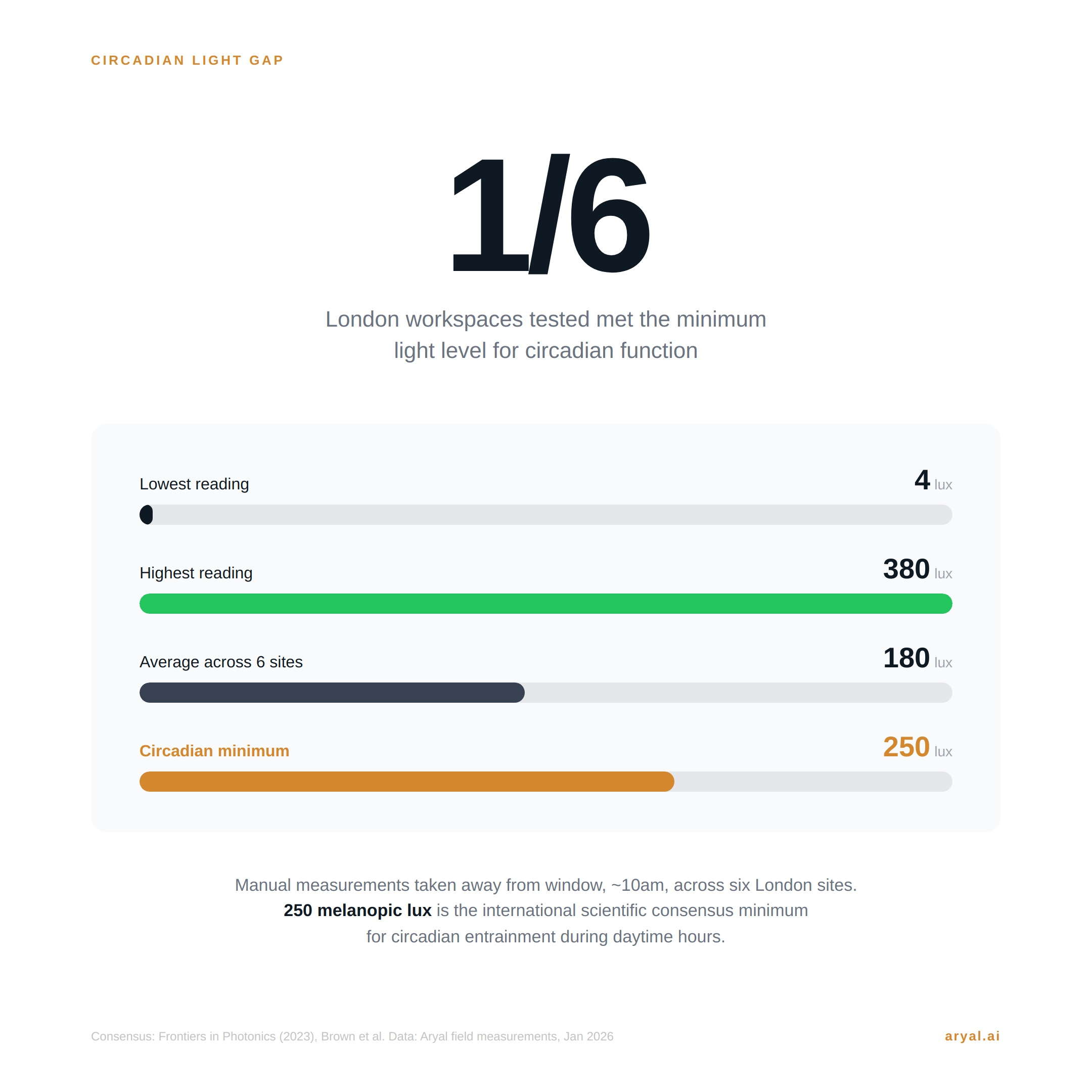
250 is the floor. Most of the places where we spend our working lives deliver less than half of that. One delivered less than 2%. Every hour you spend under the 250lux is an hour your body receives weak or no circadian signal at all.
We spend 90% of our time indoors. The problem is not the screen before bed. The problem is the entire day before the screen.
We are going to repeat this experiment with a larger dataset across more sites and seasons. If you run a workspace, a hotel, a care home, or an office and want to know what your light environment is actually delivering, get in touch.